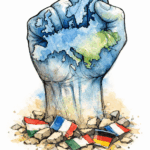

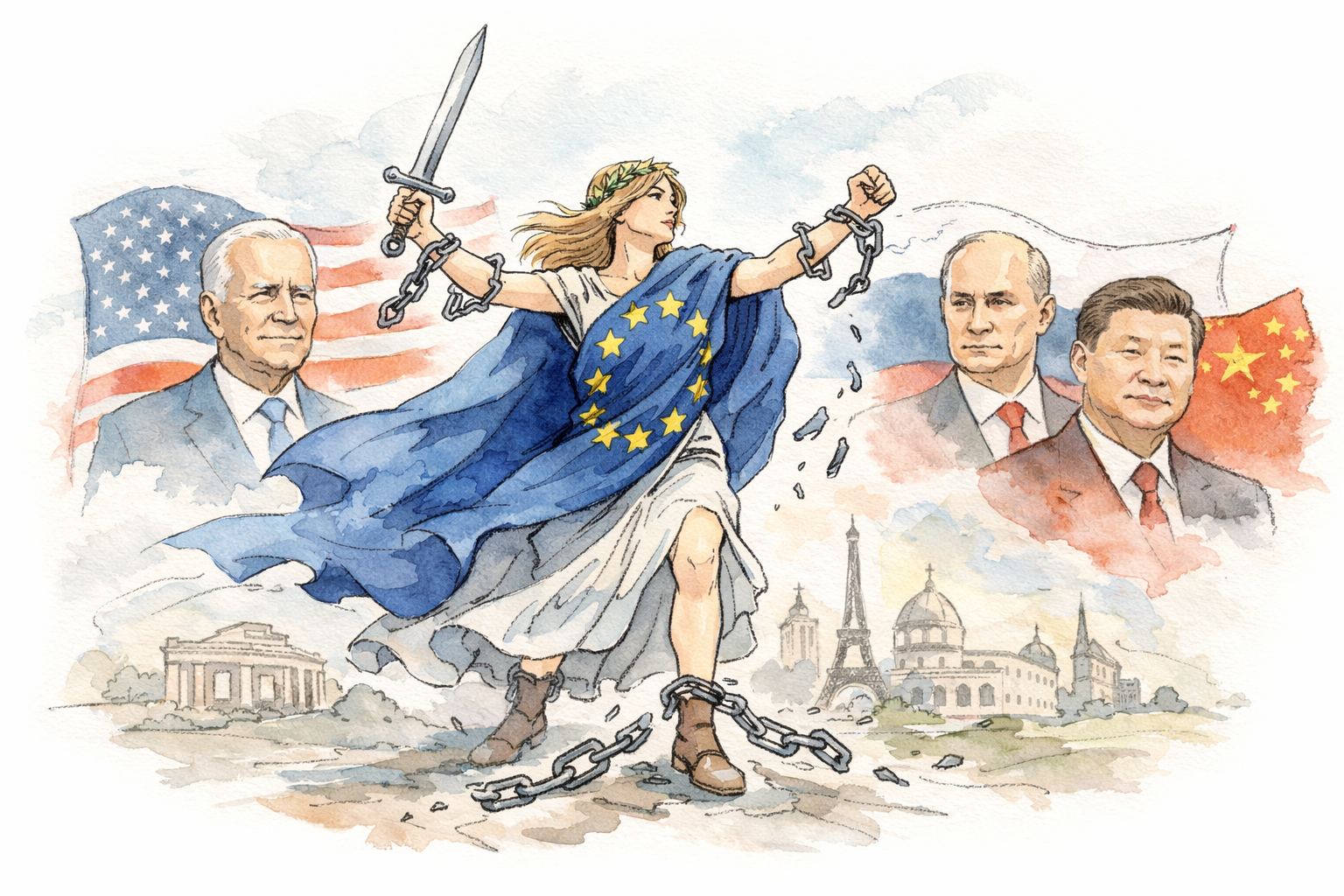
Germany in decline – Europe paralyzed
“My motto is cheerful pessimism. Since I can think politically, Germany has been going downhill. But on this long road down, there are still a number of beautiful days.”
Jan Fleischhauer, former editor of Der Spiegel, is occasionally quoted as uttering this rather sobering statement.
My reflexive inclination is to dismiss this melancholic resignation as premature self-abandonment. A thorough reality check however reveals that Jan Fleischhauer seems to be not so far off the mark.
1. Germany’s path to insignificance
The “Deutsche Bahn“, as all Germans who have ever entrusted themselves to it in good faith know, has been operating for years on the brink of total collapse. Formerly an iconic symbol of reliability, has degraded materially – particularly in long-distance operations. DB’s own reporting frames the situation as a consequence of aging infrastructure and construction backlogs, and it references stabilisation efforts and operational measures. Yes, true, but the question is legitimate: “How did we get there?” Aren’t there deeper-rooted reasons, some lack of community spirit, a wider cultural decline, rather than just occasional infrastructure underinvestment over decades?
Germanys chemical industry, once world class, is struggling as high and unpredictable energy prices let local production appear unattractive and investments resembling gambles. Although there might be cyclical factors at work as well, never before, with exception of phases after lost world wars, the pressure was felt that intense, increasingly being associated with relocation trends. Major chemical players have explicitly linked “adjustments” to the post-cheap-gas reality. BASF e.g. announced shutdowns of energy-intensive capacity and job reductions with references to changed conditions, including energy.
The fact that Europe had to exchange cheap Russian gas for expensive US LNG is usually attributed to Russia’s attack on Ukraine. While this confrontation cannot be dismissed as the core trigger, it did not arise out of nowhere. It had been carefully crafted by the two rival superpowers over two and a half decades. Our leaders meekly accepted the inconvenient truth that the tiny European states had no choice in this game of great powers but to take the role of happy vassals because, in the short term, it was simply the most convenient alternative for them.
The German automotive industry, once one of the pillars of the German economy, has been rudely awakened from its dreams. It is now playing catch-up in the electric mobility sector, while its strengths in the field of combustion engines are becoming less and less relevant. While companies are pointing to market forces that are averse to electric vehicles, potential buyers are missing attractive offers and the necessary charging infrastructure. Having completely misjudged cost curves, China’s scale and speed, the sector is now operating in a catch-up mode under now harsher competitive economics. So, there is obviously something rotten in the automotive state of Germany.
In his famous “jolt speech” [1], former German President Roman Herzog (1994–1999) already back then called for a shake-up in Germany. There may have been a few minor tremors since then, but the situation has not changed substantially.
On January 24, 2026, even Marie-Agnes Strack-Zimmermann, a staunch transatlanticist who is otherwise known for her rude tone and unacceptable messages, said something simple but true on “The Pioneer” [2], advocating for a change…
“If we continue with this petty statism in Europe, we will simply be eaten up by the US, the Chinese, and the Russians.”
… and …
“Because we no longer have reliable partners in the United States and we see that the US, China, and Russia are beginning to divide up the globe among themselves, a strong Europe is vital for our survival. And that includes a strong economy.”
It is rather questionable whether we ever had a “reliable partner in the United States”. Rather the term “happy vassal“, that has become a term of art in the recent debates in Davos [3], characterises our role up to today.
The three randomly selected examples above alone do highlight the need for action. But we are not alone. There still are our “European compatriots”. Together we are strong, right? So, what is the situation there?
2. And Europe?
The EU is rather showing signs of further disintegration. Even its name is a euphemism. This loose confederation of states is far from likening a “union,” more comparable to a poker game in which each player plays with hidden cards and intending to get as much as possible for their respective home country out of the big pot. And in fact, each member of the politically decisive Council of Ministers must first and foremost fulfil their purely national mandate.
We are probably world champions when it comes to arguing and tussling. We only find unity when our big brother from across the pond proverbially steers us in the desired direction “speaking softly while carrying a big stick.” [1]
This new tone from across the Atlantic surprises us, although it shouldn’t. James Dorsey, a senior fellow at the Nanyang Technological University of Singapore (NTU) S. Rajaratnam School of International Studies (RSIS), told Lianhe Zaobao that Donald Trump is just “more candid” than past US presidents.
“When his predecessors intervened in the country, it was to promote democracy, human rights, those were the issues that were raised. Donald Trump is blunt about it. This is about dominance. ‘This is our hemisphere, and we are going to dominate it.’”
An even more disturbing view is conveyed by Professor Calvin Jillson, Department of Political Science, Southern Methodist University. To his perception Trump seems to have a global vision in which regional hegemons hold sway, “the US in the Americas, Russia in Europe and China in Asia”.
If there is even a grain of truth in this, it should be cause for concern among the European population—not among their political leaders, who only look four or five years ahead and then only with a firm eye on their personal careers.
There are however clear-eyed observers of the scene. With respect to the currently raging Ukraine war, on January 24, 2026 Jvan Ricciardella concluded his LinkedIn post “Europe at the Crossroads of Reality“:
“The reopening of dialogue with Moscow by France, Italy, and Germany does not signal a sudden embrace of compromise, but the delayed acknowledgment of a truth Europe has struggled to face: this war cannot be managed indefinitely through slogans, sanctions, and moral absolutism. The European Union’s institutional rigidity, Britain’s reflexive escalation, America’s selective disengagement, and the erosion of global mediating structures together form a landscape in which the old rules no longer apply. Europe now stands at a crossroads, forced to choose between adapting to a multipolar reality or clinging to a fractured narrative of unity that no longer corresponds to power, credibility, or consequence. The longer this choice is deferred, the higher the price will be—not only for Ukraine, but for Europe itself.”
The sobering realization is slowly sinking into the minds of our supposed thought leaders. On Jan 24, 2026 Henry Farrell commented [4] on the first timidly defiant reactions:
“The Europeans were finally pushed to the point where they pushed back. As Belgium’s prime minister put it, ‘Living as a happy vassal is one thing, existing as a miserable slave is another.’ [5] It was clear that the Europeans were finally becoming willing to retaliate against Trump.”
Others, dictated by their profession point to the chances, this situation may offer. In the wake of the big Davos happening Nick Studer, CEO Oliver Wyman and Marsh Management Consulting, wrote on January 24, 2026 in the Oliver Wyman newsletter …
“Europe arrived in Davos under intense pressure: tariffs, Ukraine, energy security, and even Greenland. The mood was notably different from 2025, when concern over regulation and competitiveness dominated. This year, the conversation shifted toward agency.
Nowhere was this clearer than in defence. Europe is taking far greater responsibility for its own security, with sharply increased military spending, especially on hardware and advanced technologies. This is a strategic necessity but also has the potential to become economic stimulus across the EU and NATO Europe, including the UK, provided execution keeps up with ambition.
Beyond defence, the Savings and Investments Union emerged as an attempt to channel trillions in savings towards AI, data infrastructure, industrial renewal and the energy transition. Europe does not lack capital. It lacks a functioning financing continuum, speed, and will. There is much that national governments can do, and the EU must accelerate too. That gap … remains Europe’s biggest constraint.
Europe’s opportunity is real, but only for organizations prepared to navigate fragmentation, standardization challenges, and slower policy execution. The winners will help shape the ecosystem, not wait for it to settle.”
3. Europe at the crossroads
You can practically feel it: Europe has arrived at a critical moment, one of those, which occur only a few times in history, one that calls not for despair but for clarity, dignity, and renewal. If recent years have pushed the continent into a defensive posture, cast as a victim caught between the United States and China, slowed by internal frictions, and anxious about the erosion of its post-Cold War certainties, the decades ahead demand a different stance: standing upright rather than crouched, shedding the language and psychology of victimhood, and reclaiming the confidence that once made Europe a cradle of ideas, diplomacy, craftsmanship, and institutional imagination.
What Europe experiences today, is the winding down of a centuries-long cycle: the age of Western hegemony built on technological excellence, colonial reach, financial dominance, and cultural authority. That era, for which the questionable term “rule-based world order” was coined, was fading for quite a while. Now it seems to be over. The world has broadened. capabilities have dispersed. New centres of economic gravity and competence have emerged. For a while Europe enjoyed a quiet and modestly prosperous time in the backwaters of the American hegemony. With the American hegemony coming to an end however, Europe find itself rudely awakened. Its stagnation arose from the illusion that the world would orbit indefinitely around a Western centre while China rose, second line powers grew and the US overplayed its cards.
4. So, what can we do?
Yes, what can we do about it? The answer to this overwhelming question is obvious, simple, but difficult to implement: Europe unite!
Other than the current EU, we need a Europe as an entity that is self-confident, sovereign, independent, strong in terms of economy, defence and soft power, credible, reliable and globally respected, appearing monolithic to the outside world, diverse internally, reflecting its cultural richness, living up to its own ideals and values – in short, a multi-nation state, simply called “Europe”.
Who then is “we”? Well, It’s us – we, the people. We will not be salvaged by our elected representatives. They are driven by quite different, more intrinsic forces. Apparently, representatives are elected to establish policies for the people’s benefit, hereby leaving them free to pursue their livelihoods, which often is demanding enough. In theory, those representatives are sworn to reflect the will of those who elected them. In practice, once ensconced in ruling centre of gravity, far from their home bases, they are free to do pretty much as they please as Washington correspondent William Greider candidly describes in his 1992 book “Who Will Tell The People?“.
It is quite obviously the task of a grassroots movement, a community that is consistently committed to its goals, whose internal structure does not, as is usually the case, propel psychopaths to the top to wield power, that takes politics seriously and conducts it differently than has been customary up to now.
This movement already exists. It is still small. It must and will grow, spreading to all European countries that stand in the liberal tradition of the European Enlightenment.
It will work from within and from below, and it will influence our future: The Europeans for the Planet.
[1] As Theodore Roosevelt, 26th President of the United States famously proclaimed in a public speech on September 2, 1901, at the Minnesota State Fair (shortly before becoming president)