
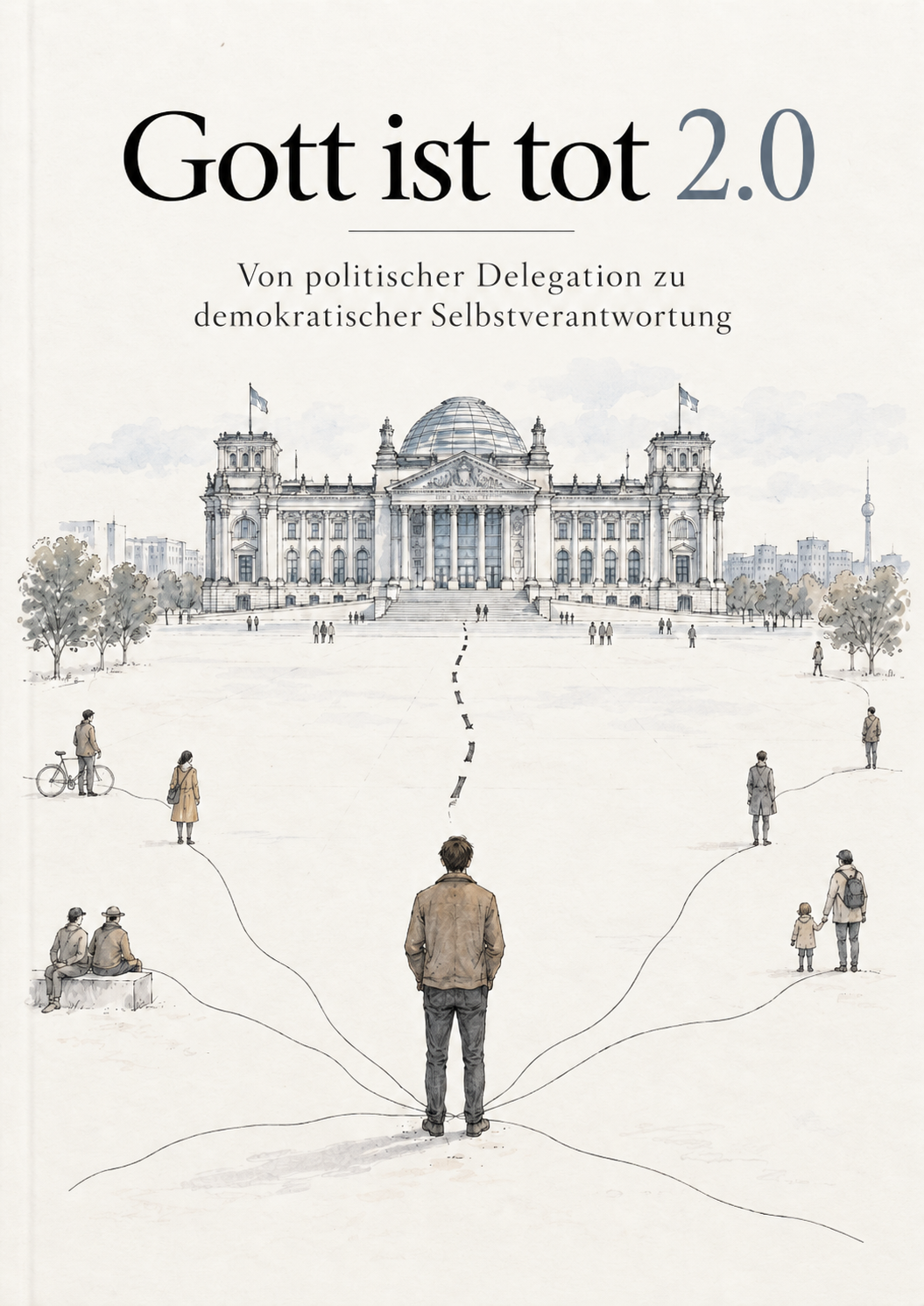
God is dead 2.0
From Political Delegation to Democratic Self-Responsibility
Preface
“God is dead.”
Few philosophical statements have travelled so far while carrying so little of their original luggage with them.
Friedrich Nietzsche’s famous sentence is commonly treated as a triumphant declaration of atheism. God existed in people’s imagination. Modern science and reason had finally disposed of Him. Humanity was now free.
But Nietzsche’s message was considerably less comfortable.
The dramatic announcement made by the madman in The Gay Science was not primarily a celebration. It was a warning. European civilisation had progressively undermined the foundations on which its inherited system of values, meaning and moral authority rested. Yet people continued to live as though the consequences could somehow be avoided.
Nietzsche’s unsettling question was therefore not simply:
- What happens when God disappears?
It was:
- Who now carries the burden that God once carried?
More than a century later, we may be approaching an analogous moment in an entirely different sphere.
Not religion. Politics.
Representative democracy remains one of humanity’s great political achievements. We elect representatives. We entrust them with authority. They deliberate, negotiate and decide on our behalf. At regular intervals, we have the opportunity to confirm or replace them.
But somewhere along the way, an assumption has taken hold that deserves examination:
that by voting every four or five years we have adequately discharged our own democratic responsibility.
Increasing numbers of citizens appear doubtful that political institutions adequately transmit their preferences into political action. Across the OECD countries surveyed in 2023, only around 30 per cent believed that their political system allowed people like them to have a say in what government did. Trust in national government differed dramatically according to perceived political agency: 69 per cent of those who felt they had a say reported high or moderately high trust, compared with only 22 per cent among those who felt they did not.
Perhaps the problem therefore runs deeper than dissatisfaction with politicians.
Perhaps citizens are discovering that democracy cannot ultimately be delegated.
If so, an inconvenient burden is returning to us.
And that is where Nietzsche becomes interesting again.
1. The Announcement Nobody Wanted to Hear
Nietzsche’s madman enters the marketplace carrying a lantern in broad daylight and looking for God.
The people laugh.
They regard themselves as enlightened enough to know that the old religious certainties are already disappearing. They do not need this eccentric figure to tell them that.
But they have misunderstood him.
His message is not that God has died.
His message is that they have not yet understood what His death means.
Nietzsche returns to the theme explicitly elsewhere in The Gay Science. The belief in the Christian God, he argues, has become unbelievable, but the full consequences of this event have scarcely begun to appear. Whole structures of European morality had grown upon that foundation. Their intellectual support could disappear before their cultural effects did. The consequences would therefore unfold slowly.
This temporal gap is fundamental. — The old certainty can disappear before society realises that it has disappeared.
- Institutions can continue.
- Vocabulary can continue.
- Habits can continue.
- People can continue behaving according to rules whose original justification they no longer accept.
One might call this an institutional afterlife. — The structure survives the conviction that once sustained it.
Nietzsche was looking into precisely such an abyss.
If the external source of ultimate meaning was no longer convincing, people would eventually face a question they had previously been able to avoid:
Who decides what is valuable now?
The disappearance of authority therefore did not remove responsibility. — It redistributed it.
And this is the first bridge toward our contemporary political problem.
For perhaps something comparable happens whenever human beings discover that an authority on which they have relied can no longer carry all the weight they have placed upon it.
The important point is not whether the authority was divine, political, organisational or intellectual. — The structural problem is the same.
- We outsourced something.
- We subsequently discovered that the recipient could not ultimately discharge it for us.
- The obligation returns.
2. After Certainty
The immediate consequence of Nietzsche’s diagnosis was not freedom in the cheerful modern sense. — It was disorientation.
If inherited values no longer possess unquestioned authority, the disappearance of constraint does not automatically produce meaningful alternatives.
Freedom from an old answer is not yet possession of a new one.
This is where nihilism enters Nietzsche’s thought.
Nihilism is easily misunderstood as pessimism. It is more serious than that. It concerns the possibility that the values by which people orient their lives have lost their binding force while nothing convincing has replaced them.
What follows?
- One possibility is despair.
- Another is nostalgia: the attempt to restore old certainties simply because uncertainty has become unbearable.
- Another is distraction.
- Another is conformity.
- And another is creation.
Nietzsche’s philosophical importance lies partly in refusing to imagine that humanity can escape this problem by looking backwards.
If the intellectual foundations of an old order have genuinely eroded, merely commanding people to believe again cannot recreate them.
The challenge is therefore one of development. — Human beings must learn to live under new conditions.
This is what makes Nietzsche so relevant to periods of upheaval.
He understood that historical transitions are psychologically asymmetrical.
- Institutions change.
- Technologies change.
- Economies change.
- Knowledge changes.
- But humans continue for a while with expectations and habits formed under the previous regime.
The physical world can move faster than the mental world.
We enter the future carrying yesterday’s behavioural equipment. — That is uncomfortable enough in private life.
- In politics it can become dangerous.
3. The Übermensch and the Last Man
Nietzsche dramatised two radically different responses to the disappearance of inherited certainty.
They appear with particular force in the Prologue to Thus Spoke Zarathustra.
The first is associated with the Übermensch.
The second with the last man.
Both concepts have accumulated enormous historical baggage. The Übermensch in particular was subsequently subjected to ideological appropriation and distortion. It would therefore be misleading to convert Nietzsche directly into a modern democratic theorist.
He was not one.
Nor should the Übermensch be reduced to the idea of a particularly capable democratic citizen.
The more useful concept for our purposes is the one underneath it:
self-overcoming.
Zarathustra describes the human being as something transitional, something to be overcome. Humanity is portrayed as a bridge rather than a finished destination.
The philosophical implication is profound. — Changed conditions can impose developmental demands.
What previously sufficed may cease to suffice.
Human beings may have to become capable of something they previously did not need to do.
The alternative is symbolised by Nietzsche’s last man.
The last man does not seek transcendence or demanding self-development.
He seeks …
- Comfort,
- Security,
- Manageability,
- Small pleasures,
- Avoidance of excessive burdens.
Nietzsche has Zarathustra describe a society in which people no longer wish seriously to rule or obey because both have become too burdensome. The last human beings congratulate themselves on having invented happiness.
This image is easy to caricature. — It should not be.
There is nothing intrinsically contemptible about wanting peace, prosperity, health and security.
The important question is what happens when the avoidance of burden becomes a civilisation’s dominant principle.
For democracy contains burdens.
- Political judgement is inconvenient.
- Information takes time.
- Compromise is frustrating.
- Participation is tiring.
- Responsibility creates exposure.
It is therefore tempting to delegate all of this to people whose profession it is to deal with politics.
And once that has occurred, an extraordinarily attractive arrangement emerges.
The citizen retains sovereignty in principle.
The representative carries its burdens in practice.
At least, that is the promise.
4. The Great Democratic Delegation
Representative democracy solved a genuine problem.
Modern political communities are too large, complex and specialised for every citizen to participate continuously in every decision.
Representation provides …
- Continuity,
- Specialisation,
- Institutional memory,
- Negotiation,
- Expertise,
- Accountability.
It makes modern government possible.
But representative government was never simply direct democracy with intermediaries added for convenience.
Bernard Manin’s historical analysis is important here. Representative government emerged with mechanisms that deliberately selected relatively few people to govern on behalf of the many. Historically, election itself possessed both democratic and selective characteristics. Manin therefore describes representative government as containing democratic as well as aristocratic elements.
This matters because we should avoid inventing a lost golden age in which representatives simply executed the wishes of voters.
They never did. — Nor should they.
Political representation necessarily entails judgement.
Representatives encounter information unavailable to most citizens. They negotiate compromises. They deal with unforeseen events. They must reconcile competing interests. They operate within constitutional limits.
A representative is therefore not merely a courier carrying instructions from voters to parliament. — But neither does election logically extinguish the role of the citizen.
Here a comparison with ordinary organisational delegation becomes useful.
Suppose a board delegates a major responsibility to an executive.
Serious delegation would ordinarily include several elements.
- An objective is defined.
- Authority is granted.
- Resources are provided.
- Expectations are clarified.
- Progress is observed.
- Results are reported.
- Performance is evaluated.
- Deviations are explained.
And, if necessary, the mandate can be modified or withdrawn.
What delegation normally does not mean is:
“I have transferred the responsibility. I therefore no longer need to know what happens.”
Strangely, our democratic understanding can come remarkably close to precisely that model.
- The citizen authorises.
- The representative acts.
- The citizen watches politics principally through media.
- Several years later, the citizen again authorises or rejects.
- The feedback loop is extraordinarily long.
- And the principal has only limited structured visibility into whether the agent’s actions continue to reflect the evolving preferences of those represented.
The analogy must not be pushed too far.
- Citizens are not shareholders.
- Members of parliament are not employees.
- The political mandate is constitutionally different from managerial delegation.
Nevertheless, the comparison reveals an important distinction:
delegation is not abandonment.
Democratic delegation can give representatives substantial freedom of judgement without requiring citizens to disappear from the process between elections.
And yet disappearance has become remarkably normal.
5. When the Principal Disappears
Something peculiar can therefore happen in mature representative democracies.
Citizens remain formally sovereign. — But sovereignty becomes episodic.
For a brief period surrounding an election, citizens are intensely courted.
Parties publish programmes.
- Candidates travel.
- Debates proliferate.
- Promises are made.
- The electorate decides.
Then the political system changes mode.
- Citizens return largely to the audience.
- Professional politics resumes the stage.
This is not necessarily the result of bad intentions.
The institutional incentives are powerful.
- Politics requires specialised knowledge.
- Legislative work is time-consuming.
- Government operates continuously.
- Media cycles reward personalities and conflict.
- Parties require organisations.
- Organisations develop internal interests.
- Careers emerge.
The distance between citizen and decision grows incrementally rather than conspiratorially.
Eventually, however, the formal statement …
“all state authority derives from the people”
… can coexist with an everyday experience in which many citizens feel that little meaningful authority derives from them personally.
This is where contemporary empirical evidence becomes significant.
The OECD’s 2024 trust survey found that across the participating countries, only 37 per cent reported high or moderately high trust in national parliaments and only 24 per cent in political parties. More importantly for our argument, only around 30 per cent believed their political system gave people like them a meaningful say.
We should be careful with these numbers.
- Distrust does not prove institutional failure.
- Public dissatisfaction can have many causes.
- Citizens can hold unrealistic expectations.
- Partisan differences matter.
- Countries vary enormously.
But one finding is difficult to ignore.
The factor associated most strongly with trust was not simply income, education, gender or age. — It was political agency.
Among respondents who felt that they had a say in what government did, 69 per cent reported high or moderately high trust in national government.
Among those who believed they did not have such a say, the corresponding figure was 22 per cent.
That does not establish causation by itself. — But it suggests a hypothesis worth taking seriously.
Perhaps the democratic problem is not primarily that citizens have lost trust in politicians.
Perhaps many citizens have lost the experience of being politically consequential.
That is a different diagnosis. — And it leads to a different remedy.
6. God Is Dead 2.0
We can now return to Nietzsche.
The analogy should not be misunderstood.
- God is not the state.
- Politicians are not priests.
- Elections are not religious rituals.
- Representative democracy is not dead.
- Nietzsche did not foresee digital participation or design a theory of deliberative democracy.
The comparison concerns something more abstract.
It concerns the collapse of a convenient transfer of responsibility.
Nietzsche’s Europeans had inherited an order in which ultimate meaning could be located outside themselves.
When confidence in that order eroded, the uncomfortable consequence was not that human beings had escaped responsibility. — It was that responsibility had returned to them.
Our political situation may contain a structurally similar development.
For generations, citizens in representative democracies have been able to live with a convenient assumption:
- We choose competent people.
- They govern.
- We judge them later.
But what if this model no longer produces a sufficient experience of political representation?
- What if societies have become too complex, politics too professionalised, information flows too immediate and citizens too educated and interconnected for political agency to be compressed into an election every few years?
- What if technological capabilities have changed faster than the institutional architecture of democracy?
- What if citizens can now communicate, deliberate, analyse and organise at a scale that was impossible when representative institutions took their familiar form?
Then a new question emerges.
Not:
How do we find better rulers?
But:
How do citizens recover their position as the continuing principals of democratic government?
- This is the central proposition of God Is Dead 2.0.
The old assumption has not necessarily collapsed completely. — But it has become unsafe.
We can no longer simply assume that periodic electoral delegation adequately fulfils citizens’ democratic sovereignty.
And if that assumption weakens, the responsibility it once carried returns to us.
That is the inconvenient truth.
- Democracy cannot finally be delegated away.
7. The Political Last Man
At this point it would be very easy to blame politicians.
That would also be too easy.
A crisis of representation has at least two sides.
Representatives can become distant from the represented. — But citizens can become distant from citizenship.
The political last man is therefore not a corrupt politician.
- He is one of us.
- He believes strongly in democracy.
- He complains about government.
- He distrusts politicians.
- He follows scandals.
- He votes.
- He expects functioning public services, security, prosperity, environmental protection, social cohesion and competent crisis management.
But sustained engagement with political decision-making appears to him as someone else’s responsibility.
Politics is something politicians do. — Citizens observe.
This position is understandable.
Life already demands enormous amounts of attention.
- People work.
- They raise children.
- They care for relatives.
- They commute.
- They deal with bureaucracy.
- They pursue professions, friendships, interests and private responsibilities.
A political theory that responds to democratic alienation by commanding every citizen to become a part-time constitutional scholar will fail before it begins.
Nevertheless, there is a contradiction we should confront.
- We insist that sovereignty belongs to us.
- But we practise democracy as though sovereignty belonged to them.
- We demand that “politicians listen to the people”.
- But by what continuous mechanism should “the people” speak?
- We complain that parties have become detached from citizens.
- But how many citizens are prepared to invest time in political organisations?
- We deplore decisions taken over our heads.
- But we have built systems in which political involvement between elections often requires exceptional motivation.
This is the uncomfortable Nietzschean moment.
The solution is not simply that representatives must improve. — Citizens must also change their relationship with politics.
Not because they have failed morally. — Because the operating environment has changed.
8. Human 2.0
Here we should depart explicitly from Nietzsche.
Democracy does not need an Übermensch. It certainly does not need a supposedly superior political class. Nor does it need a charismatic redeemer who promises to embody “the people”. Modern history gives ample reason to be wary of anyone who claims such a role.
What Democracy 2.0 requires is something more modest and more demanding at the same time. — A citizen capable of functioning under changed democratic conditions.
We might call this citizen Human 2.0.
The phrase does not signify biological development. — Nor moral superiority.
Human 2.0 is not “better” than Human 1.0.
The difference is functional:
A type of citizenship adapted to a democratic environment in which passive delegation is no longer sufficient.
Human 2.0 moves:
- from political consumer to political co-owner,
- from occasional voter to continuing democratic principal,
- from spectator to participant,
- from demanding responsiveness to helping create the information to which representatives can respond,
- from saying
- “They should solve this”
toward also asking
- “What is our role in solving it?”
This does not require constant political activity. — It requires the capacity for meaningful activity when relevant.
A functioning citizen in Democracy 2.0 should at least be able:
- to obtain understandable information,
- to distinguish evidence from assertion,
- to register preferences,
- to explain priorities,
- to encounter competing arguments,
- to revise a position,
- to participate in collective judgement,
- to observe representative action, and
- to hold delegated authority accountable.
This is self-overcoming translated into democratic language.
Not Nietzsche’s Übermensch. — But an analogous developmental response to a changed environment.
9. There Is No Single “Will of the People”
At precisely this point we encounter the greatest danger in our argument.
If representatives are to reflect citizens more continuously, why not simply ask citizens what they want and implement the majority preference?
Because democracy is not a continuous opinion poll.
“The people” do not possess one homogeneous will waiting to be discovered.
Citizens disagree. — Sometimes fundamentally.
- Preferences change. — Information changes them.
- Deliberation changes them.
- Different questions activate different interests.
- Intensity varies.
- Minorities matter.
- Fundamental rights impose limits upon majorities.
- Future generations cannot vote.
- Children cannot vote.
- Nature cannot vote.
Those most affected by a decision may be poorly organised.
Those most vocal may not be most numerous.
And some choices involve consequences that become visible only years later.
A Democracy 2.0 reduced to instantaneous digital plebiscites could therefore make democracy worse rather than better.
- Clicking is not deliberating.
- Aggregation is not judgement.
- Popularity is not legitimacy.
The goal cannot simply be to measure public opinion with greater frequency.
We need something more sophisticated:
observable democratic preference formation.
The word formation is crucial.
Political preferences are not merely pre-existing objects. — They develop.
- A citizen may initially support policy A.
- After learning about its costs, she may prefer B.
- After hearing how B affects a minority, she may favour C.
- After discovering that C is legally impossible, she may return to a modified A.
That movement is not democratic weakness. — It is democratic reasoning.
The process therefore needs at least six components:
- Information,
- Expression,
- Deliberation,
- Aggregation,
- Representation,
- Accountability.
Only together do these begin to constitute meaningful democratic agency.
This is also why participation and representation should not be treated as rivals.
Contemporary democratic theory increasingly understands them as complementary forms of citizenship rather than mutually exclusive alternatives.
- Democracy 2.0 is therefore not direct democracy with better software. — It is representative democracy with a much richer nervous system.
10. Verifiable Representation
This leads to the central institutional idea.
What might verifiable representation mean?
Not obedience.
A representative should not be reduced to a remote-controlled voting device.
Judgement remains indispensable. — But representation should become more observable.
Consider five levels.
1. Preference visibility
Citizens should be able to express priorities and positions in structured ways between elections.
Not on every question. Not continuously. — But sufficiently for meaningful patterns to emerge.
2. Deliberative visibility
It should be possible to distinguish raw preference from considered preference.
What happens …
- When citizens receive evidence?
- When counterarguments are heard?
- When trade-offs become visible?
A serious democracy should care not only what people initially think, but also what they conclude after reflection.
3. Representative visibility
Citizens should be able to see how representatives act on significant issues.
Voting records are not enough.
Political action also includes agenda-setting, negotiation, amendment, coalition-building and prioritisation.
4. Deviation visibility
Where representative action differs materially from visible citizen preference, that divergence should be observable.
Not automatically condemned. — Observed.
5. Explanation
The representative retains the right to disagree.
But disagreement acquires a reciprocal obligation:
explain why.
- Perhaps new evidence emerged.
- Perhaps constitutional constraints intervened.
- Perhaps another legitimate interest had to be protected.
- Perhaps compromise was necessary.
- Perhaps the representative simply believes that the majority is wrong.
All of those can be legitimate.
But representation improves when divergence becomes the beginning of political communication rather than the end of it.
Democracy 1.0 asks primarily:
Who did we elect?
Democracy 2.0 adds:
What did we ask?
What did they do?
Where did the two diverge?
And why?
This does not destroy representative freedom. — It makes representation legible.
11. Participation Without Exhaustion
A common objection now becomes obvious.
- Who has time for all this?
It is a serious question.
The last thing a modern democracy needs is an additional bureaucratic burden imposed upon citizens in the name of participation. If Democracy 2.0 requires heroic levels of engagement, it will immediately reproduce inequality. Those with more time, education and resources will dominate.
Participation therefore has to become selective, modular and practical.
- A citizen interested in environmental policy need not participate in pension reform.
- A physician may contribute expertise to health policy.
- A parent may participate in educational questions.
- Someone else may choose to concentrate on local transport.
Participation can intensify around issues that matter to the person. — Then recede again.
This creates a fundamentally different political architecture from membership in a permanent professional political class.
Citizens remain ordinary citizens.
Politics enters their lives when relevant. — Then leaves again.
Representative deliberative processes already demonstrate pieces of this logic.
Citizens’ assemblies, juries and panels have increasingly been used for complex public-policy questions. The OECD has documented their growing use and has developed principles for designing and evaluating such deliberative processes.
They are not a universal answer. — But they demonstrate something important:
ordinary citizens, given time, information and appropriate structures, can deliberate seriously about difficult political questions.
Democratic competence is not confined to a political profession.
12. Technology Changes What Is Possible
Representative democracy developed under conditions of severe communication constraints.
- Large populations could not deliberate simultaneously.
- Information travelled slowly.
- Translation was expensive.
- Aggregation was cumbersome.
- Political participation at scale required physical organisation.
Representatives were therefore partly a technology of communication. They compressed millions of citizens into a manageable institutional structure.
But the technological environment has changed.
- Communication is effectively instantaneous.
- Large-scale preference gathering is inexpensive.
- Translation can increasingly occur automatically.
- Documents can be searched and summarised.
- Arguments can be structured.
- Citizens can participate asynchronously.
- Complex legislative histories can be made accessible.
- Representatives can communicate directly with constituencies.
This changes what is institutionally possible.
The OECD has begun examining how emerging technologies can support participation, while emphasising that meaningful opportunities for voice—not technology by itself—are what matter for democratic trust and agency.
Artificial intelligence potentially expands these capabilities dramatically.
It could help citizens …
- Understand complex proposals,
- Compare arguments,
- Identify consequences,
- Translate discussions,
- Expose inconsistencies,
- Summarise deliberations,
- Reveal minority positions,
- Connect related proposals,
- Track commitments,
- Reduce information overload.
But this creates a second danger.
If citizens once delegated political responsibility to representatives, they may now be tempted to delegate it again — this time to machines.
That would be Democracy 2.0’s original sin.
Artificial intelligence may support judgement. It must not become the bearer of sovereignty.
A democratic assistant can say:
“Here are the competing arguments.”
It can say:
“Your previous position appears inconsistent with this preference.”
It can say:
“These are the likely consequences according to the available evidence.”
It should not become the source of the answer:
“Therefore, this is what society must choose.”
The citizen must remain the political subject.
Technology is infrastructure. — Not sovereign.
13. Democracy 2.0
We can now attempt a definition:
Democracy 2.0 is a constitutional representative democracy in which citizens remain continuously capable of observing, informing, influencing and evaluating the exercise of authority delegated in their name.
The formulation is intentionally conservative.
- Representative democracy remains.
- Parliaments remain.
- Governments remain.
- Political parties remain.
- Elections remain.
- The rule of law remains.
- Independent courts remain.
- Rights remain protected from transient majorities.
What changes is the relationship between election days.
- Representation is supplemented by participation.
- Participation by deliberation.
- Deliberation by information.
- Delegation by observability.
- Authority by accountability.
- And all of them by technology capable of making participation scalable.
This is evolution, not revolution.
Democracy 2.0 does not destroy Democracy 1.0. — It completes functionality that earlier technological and social conditions made difficult to provide.
The relationship might be expressed simply:
Democracy 1.0:
elect → delegate → observe → elect again.
Democracy 2.0:
elect → inform → deliberate → express → delegate → observe → explain → correct → elect again.
This also clarifies what Democracy 2.0 is not.
- It is not government by referendum.
- It is not permanent opinion polling.
- It is not government by social media.
- It is not rule by activists.
- It is not digital populism.
- And it is certainly not AI government.
It is an attempt to reconnect political sovereignty with the people to whom democratic constitutions already say it belongs.
14. Monday Morning
Philosophical arguments eventually face a brutal test.
- Fine. What do we do next Monday morning?
The honest answer is:
We do not yet know completely.
And we should distrust anyone who claims otherwise.
We are entering institutional territory that has not yet been fully mapped.
That should not discourage experimentation. — It should discipline it.
The first task is not to design the perfect Democracy 2.0.
It is to test mechanisms through which citizens can recover agency without destroying the advantages of representative institutions.
Political parties provide one obvious experimental environment.
- They already aggregate political preferences.
- They already possess organisational structures.
- They already nominate candidates.
- They already connect citizens with formal political institutions.
But the traditional mass-membership party is itself under pressure.
One possible response is the members’ party in a more literal sense:
an organisation in which members are not mainly campaign volunteers, donors or voting delegates, but continuing participants in political formation.
Such a party might experiment with:
- continuous issue consultation,
- structured online deliberation,
- temporary expert groups,
- transparent argument repositories,
- member-initiated agenda items,
- multilingual participation,
- traceable programme development,
- explanations of deviations between membership preferences and leadership decisions,
- rotation of responsibilities, and
- technology designed to lower the cost of meaningful participation.
This is one of the questions currently being explored within Europeans for the Planet.
The party does not possess the finished answer.
Nor should it pretend to.
Its significance, if it proves useful, lies in treating its own organisation as a laboratory for a broader democratic question:
Can a political party remain organisationally effective while making members more rather than less politically sovereign?
The same experiments can occur outside parties, for example through:
- Citizens’ assemblies.
- Participatory budgeting.
- Local deliberative forums.
- Issue-specific participation.
- Public consultations with genuine feedback obligations.
- Digital policy platforms.
- New forms of temporary public service.
The important point is not the particular mechanism. — It is the direction.
Citizens cease to be treated principally as recipients of political communication. — They become participants in political formation.
15. No Saviour Will Come
There remains one final temptation.
Periods of democratic dissatisfaction often produce demand for someone who will solve the problem for us.
- A strong leader.
- A brilliant outsider.
- An incorruptible technocrat.
- An enlightened elite.
- A perfect party.
- Perhaps soon an artificial intelligence that promises to calculate the public good more rationally than politicians ever could.
This temptation is understandable.
Responsibility is heavy. — Uncertainty is unpleasant.
Delegation offers psychological relief.
But here the Nietzschean circle closes.
If the crisis originates partly in citizens having surrendered too much practical agency, another act of surrender cannot resolve it.
Democracy 2.0 therefore has …
- No political Übermensch.
- No leader can relieve sovereign citizens of sovereignty.
- No algorithm can carry democratic legitimacy on their behalf.
- No party can own the political will of the people.
- No expert can eliminate value conflicts through expertise.
- No representative, however conscientious, can permanently substitute for an absent citizenry.
Hence …
- Leadership remains necessary.
- Representation remains necessary.
- Expertise remains necessary.
- Institutions remain necessary.
But none of them removes the underlying democratic fact:
the principal is still us.
16. The Burden Returns to Us
Nietzsche’s announcement was terrifying because it removed an escape route.
If the inherited source of ultimate meaning had become unbelievable, human beings could no longer avoid the question of what they themselves would affirm.
The disappearance of certainty was therefore also the appearance of responsibility.
Our democratic predicament may be less dramatic. — But its structure is familiar.
Representative government remains indispensable.
Yet the comfortable assumption that citizens can transfer their political responsibility every four or five years and briefly recover it at the ballot box appears increasingly inadequate:
- Our societies have changed.
- Our technologies have changed.
- Our information environment has changed.
- Our ability to communicate has changed.
- Our expectations have changed.
The institutions of democracy must therefore be capable of development as well.
This does not require abandoning what representative democracy has achieved. — On the contrary.
It requires preserving its achievements by addressing one of its unresolved weaknesses:
the gradual transformation of sovereign citizens into political spectators.
There will be no final institutional design, because …
- Democracy is not a machine that can one day be completed.
- Every solution creates new risks.
- Participation can become populism.
- Transparency can become surveillance.
- Deliberation can become manipulation.
- Technology can become control.
- Majorities can become oppressive.
- Experts can become oligarchies.
- Representatives can become detached.
- Citizens can become exhausted.
Democracy 2.0 must therefore remain constitutional, pluralistic, experimental and self-correcting.
- Its ambition is not perfection.
- Its ambition is maturity.
Nietzsche confronted his contemporaries with the possibility that humanity could no longer remain what it had been because the world that had made that condition possible was disappearing.
Our challenge is more modest but perhaps no less consequential. We may have to rediscover what democratic sovereignty demands of the sovereign.
That rediscovery begins with an inconvenient insight.
- The representatives remain.
- The institutions remain.
- The elections remain.
But none of them can finally relieve us of responsibility for the political world we inhabit.
- The burden returns to us.
And perhaps that is not merely a burden. — Perhaps it is democracy’s unfinished promise.
The representatives remain.
But the citizens must return.
Annotated References
- Leiter, B. (2015). Nietzsche on morality (2nd ed.). Routledge.
- Leiter provides an influential naturalistic interpretation of Nietzsche and is particularly useful as a safeguard against romanticising or politically appropriating his philosophy. For the present essay, its principal value lies in reminding us that Nietzsche’s critique of morality and agency cannot simply be translated into contemporary democratic terminology. The democratic use of Nietzsche developed here is therefore explicitly analogical rather than exegetical.
- Manin, B. (1997). The principles of representative government. Cambridge University Press.
- Manin’s historical analysis is essential to avoiding an idealised account of representative democracy. He demonstrates that representative government emerged with both democratic and selective features and was historically distinguished from direct popular rule. His discussion of the selective or “aristocratic” properties of election is particularly relevant to the argument that representation should not be understood merely as the mechanical transmission of popular preferences.
- Nietzsche, F. (2001). The gay science (J. Nauckhoff, Trans.; B. Williams, Ed.). Cambridge University Press. (Original work published 1882/1887).
- The indispensable primary source for the “death of God”. Sections 108, 125 and 343 are particularly important. The madman passage provides the dramatic formulation, while Nietzsche’s later discussion clarifies that the event concerns the diminishing credibility of the Christian foundation of European morality and the as-yet-unrecognised consequences of that development. The present essay borrows the structural problem—the return of responsibility after inherited authority loses credibility—rather than attempting to equate theology with politics.
- Nietzsche, F. (2006). Thus spoke Zarathustra: A book for all and none (A. Del Caro, Trans.; R. B. Pippin, Ed.). Cambridge University Press. (Original work published 1883–1885).
- The principal source for the Übermensch, the last man and the language of self-overcoming used in the essay. Zarathustra’s Prologue contrasts humanity understood as transitional with the last man’s preference for comfort and diminished aspiration. The present argument deliberately does not transform the Übermensch into a democratic citizen ideal; instead, it transfers the more general concept of self-overcoming to changing democratic circumstances.
- OECD. (2020). Innovative citizen participation and new democratic institutions: Catching the deliberative wave. OECD Publishing. https://doi.org/10.1787/339306da-en
- A major empirical resource on citizens’ assemblies, juries, panels and other representative deliberative processes. The report demonstrates that structured citizen deliberation is no longer merely theoretical: numerous governments have experimented with institutional formats that combine representative sampling, information, deliberation and recommendation. It provides an important empirical bridge between the philosophical argument for renewed agency and feasible institutional experimentation.
- OECD. (2024). OECD survey on drivers of trust in public institutions – 2024 results: Building trust in a complex policy environment. OECD Publishing. https://doi.org/10.1787/9a20554b-en
- The principal empirical source supporting the essay’s focus on political agency. Across the surveyed OECD countries, trust in national parliaments and political parties was relatively low, but the more important finding is the relationship between perceived voice and institutional trust. Respondents who believed they had a say in government reported dramatically higher levels of trust than those who believed they did not. This does not prove the essay’s thesis, but it strongly justifies treating political agency as a serious democratic variable.
- Pitkin, H. F. (1967). The concept of representation. University of California Press.
- Pitkin’s classic study remains foundational for distinguishing different meanings of representation and, in particular, for treating substantive representation as more complicated than either descriptive resemblance or formal authorisation. It is especially important for the concept of “verifiable representation” developed in this essay.
- Reginster, B. (2006). The affirmation of life: Nietzsche on overcoming nihilism. Harvard University Press.
- Reginster provides one of the major systematic interpretations of Nietzsche’s response to nihilism. The work is useful for connecting Nietzsche’s critique of inherited values with the problem of overcoming rather than merely diagnosing nihilism, and provides deeper philosophical support for Sections 2, 3 and 8.
- Urbinati, N., & Warren, M. E. (2008). The concept of representation in contemporary democratic theory. Annual Review of Political Science, 11, 387–412. https://doi.org/10.1146/annurev.polisci.11.053006.190533
- Especially important to the constructive thesis of the essay. Urbinati and Warren identify a major development in democratic theory: participation and representation need not be treated as competing models but can instead function as complementary forms of citizenship. This provides theoretical support for Democracy 2.0 as an extension of representative democracy rather than its replacement.