
Why a Political Party at All?
From Civic Alarm to Political Consequence
In our previous contribution “From paralysis to action – a stepwise approach” we described a familiar but deeply uncomfortable situation. The words are spoken. The warning signs are there. The scientific findings are published. The declarations, speeches, targets and solemn promises are present as well.
And yet, the necessary action does not follow.
This is not mainly a problem of missing information. Nor is it simply a problem of individual bad will. It is a political problem. More precisely: it is a problem of political implementation. Democratic societies know far more than they are currently able to translate into durable, courageous and long-term action.
That observation leads us to the first of the seven questions we promised to address:
Why a political party at all?
What: The vehicle of choice is a political party
Our strategic statement is simple:
Those who want lasting political influence in a parliamentary democracy must eventually use the constitutional vehicle through which political will is formed, elections are contested, laws are shaped and responsibility can no longer be avoided. That vehicle is the political party.
This is not because political parties are beautiful. They are not.
They are often boring, cumbersome, slow, vain, tactical, inward-looking and inclined to age badly. They can become machines for careers rather than instruments of responsibility. They can speak of the future while organising themselves around the next election. They can start as movements of conviction and end as bureaucracies of self-preservation.
We know all that.
Indeed, much of what we have written so far has been a critique of ordinary party politics: its short-termism, its obsession with personalities, its permanent campaigning, its avoidance of uncomfortable decisions and its tendency to turn politics into performance.
So let us be clear from the beginning:
We did not choose the party form because we love party politics. We chose it because, in a parliamentary democracy, political transformation needs an organised, legitimate and durable vehicle.
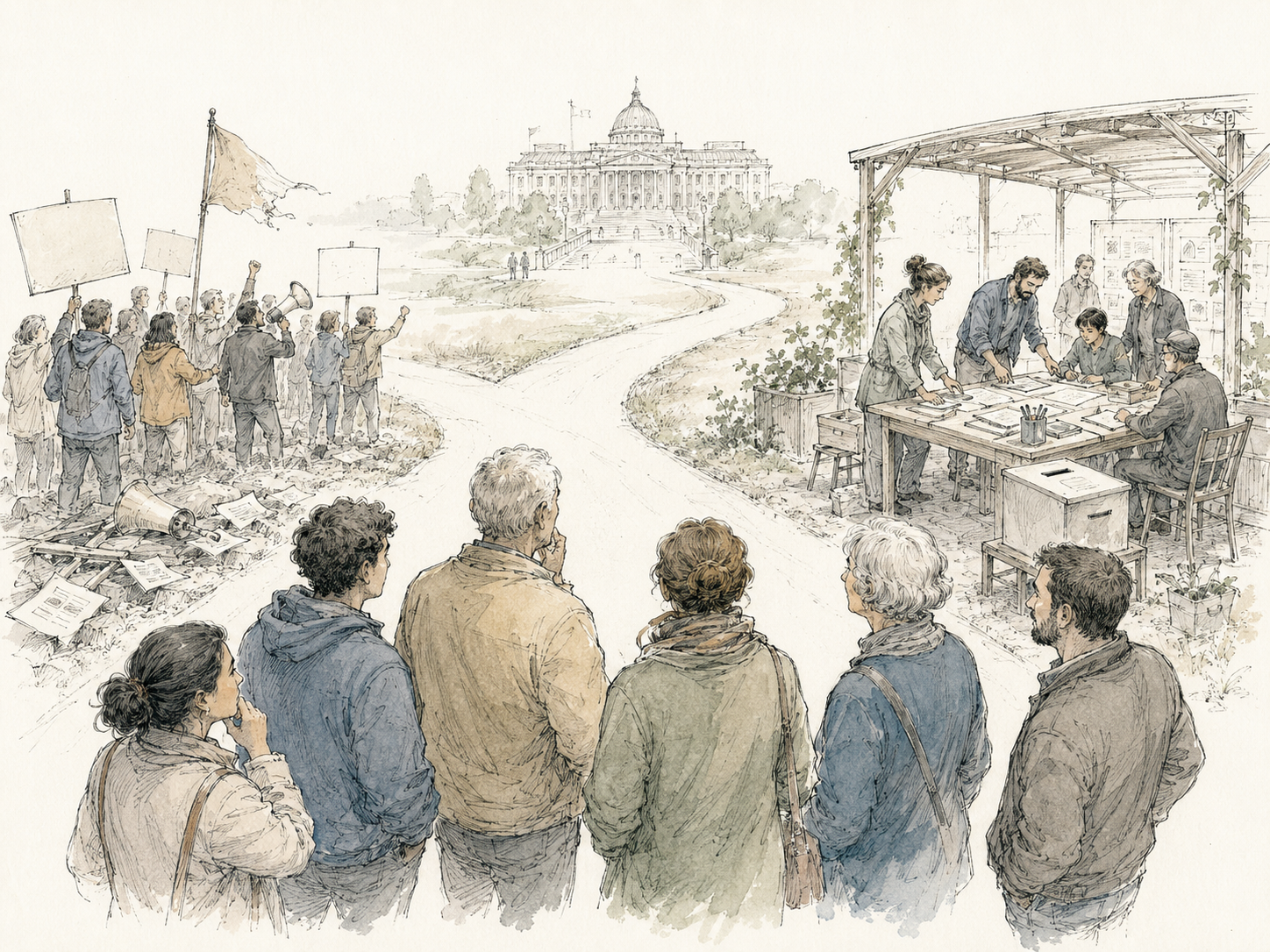
- A citizens’ initiative can awaken.
- A protest can irritate.
- A movement can mobilise.
- A foundation can educate.
- A think tank can advise.
- A campaign can create pressure.
But none of these alone can reliably contest elections, enter parliaments, shape legislation, assume responsibility, or endure beyond the wave of attention that first created them.
For that, a political party remains the decisive democratic instrument.
How: Europeans for the Planet already chose this form
Yes, we founded Europäer für den Planeten — Europeans for the Planet as a political party.
We did so deliberately.
The party has a programme and statutes. It has members. It meets. It discusses. It is listed in the party-document collection of the Federal Returning Officer. It exists not merely as an idea, not merely as a website, not merely as a moral appeal, but as an institutional vehicle.
But this is only the beginning.
We do not intend to become merely another ordinary party in the crowded marketplace of promises. We are not interested in adding yet another logo, another slogan, another heroic leader portrait, another round of loud indignation, another theatre of outrage.
The party form is our vehicle. It is not our idol.
That distinction matters.
A vehicle is something one uses for a purpose. It must be maintained, steered, repaired and, when necessary, redesigned. It should not become the journey itself. A political party is useful only if it remains subordinate to its mission.
For us, that mission is clear:
to help secure the long-term survival of humanity in an intact environment, while preserving Europe’s liberal freedoms and strengthening Europe’s capacity to act in a dangerous world.
That is too large a task for occasional outrage.
- It requires continuity.
- It requires discipline.
- It requires learning.
- It requires institutional memory.
- It requires citizens who are willing to become politically responsible, not merely politically disappointed.
Why: Movements can awaken, but parties can endure
Why did we choose the boring and cumbersome path?
Why not simply stir emotions, grow a grassroots movement, dominate social media for a few months, fill streets, invent hashtags and hope that established politicians finally understand?
Because we have seen this pattern before.
Modern movements can rise quickly. They can be impressive, moving and morally necessary. They can force issues into public consciousness. They can break through silence. They can give courage to people who thought they were alone.
But they often struggle with the next step: converting mobilisation into institutions, institutions into power, and power into lasting responsibility.
The exhilaration of mobilisation is not the same as the capacity to govern.
That is not an argument against movements. On the contrary: without movements, democracies become lazy. But without institutional vehicles, movements often disperse, radicalise, are absorbed by existing parties, or fade when media attention moves elsewhere.
Political parties, by contrast, are designed for duration. That is both their strength and their weakness.
Their strength is that they can participate in elections, form parliamentary groups, influence legislation, recruit candidates, build programmes and remain visible over time.
Their inherent weakness is that they can become self-serving organisations. Robert Michels famously warned that organisations, even democratic ones, tend towards oligarchy as leadership, routine, expertise and control over resources accumulate at the centre.
Anyone who founds a party and does not understand this danger is naïve.
We are not naïve.
We did not found a party because we are blind to the risks of party politics. We founded one precisely because we know those risks — and because we want to design against them from the beginning.
That is why the later articles in this series matter.
A party can become detached from its members. So we will ask why we call ourselves a members’ party.
A party can become a career ladder. So we will ask why we want all of us to be part-time politicians — and no one a career politician.
A party can lead to a leader cult. So we will ask why programme must come before person.
A party can become a noisy spectacle. So we will ask why a boring but consistent approach may be more serious than permanent agitation.
A party can become intellectually hollow. So we will ask why members need access to a shared political knowledge base — something like a “political oracle”: not a priesthood, not a propaganda machine, but an accessible explanation of our world view, our reasoning and our programme.
In other words: the answer to the weaknesses of parties is not to avoid organisation altogether. The answer is to organise differently.
What follows: From spectators to political adults
This is perhaps the most uncomfortable conclusion.
If we want democratic politics to do the right thing, we cannot remain mere spectators of democratic politics.
We cannot complain endlessly about career politicians and then leave politics entirely to them.
We cannot criticise meaningless programmes and then refuse the labour of programme work.
We cannot reject leader cults and then secretly wait for a strong figure to rescue us.
We cannot demand long-term responsibility and then engage only when a crisis is already visible on the evening news.
A functioning democracy does not consist only of voters. It also requires citizens willing to share the burden of political judgement.
That does not mean that everyone must become a full-time politician. Quite the opposite. Perhaps one of the great failures of our current system is that it has allowed politics to become a separate profession, while citizens are reduced to occasional applause, irritation or despair.
We need more citizens who are willing to become part-time political adults.
- Not fanatics.
- Not followers.
- Not careerists.
- Not ornamental members.
- Not spectators with voting rights.
Political adults.
People who are willing to think, learn, discuss, decide, revise, organise and accept responsibility for the consequences of public choices.
That is why we chose the party form.
Not because it is glamorous. It is not.
Not because it is easy. It is not.
Not because parties are immune to corruption, vanity or decay. They are not.
But because, in a parliamentary democracy, the long road from civic alarm to political consequence must pass through institutional responsibility.
A political party is not the mission.
It is the vehicle.
And if the existing vehicles are taking us in the wrong direction, then citizens have two choices: remain passengers — or build and steer a better one.
Next Friday, we will address the second question:
Why did we Europeans establish a German party?
Annotated references
Basic Law for the Federal Republic of Germany, art. 21.
- Article 21 is the constitutional anchor for the claim that parties are not merely private associations, but institutions with a defined democratic function. It states that political parties participate in the formation of the political will of the people. For the present article, this supports the central argument that a party is the recognised democratic vehicle through which political will can be organised, contested and translated into responsibility.
Bundeswahlleiterin. (2026). Parteiunterlagen zum Download. https://www.bundeswahlleiterin.de/parteien/unterlagensammlung/downloads.html
- This source provides the factual reference for the statement that Europäer für den Planeten appears in the official party-document collection. It should be used with precision: the listing does not imply endorsement by the Federal Returning Officer. The page makes clear that the documents are made available for information purposes under the Political Parties Act and that the parties themselves remain responsible for their content.
Katz, R. S., & Mair, P. (1995). Changing models of party organization and party democracy: The emergence of the cartel party. Party Politics, 1(1), 5–28. https://doi.org/10.1177/1354068895001001001
- Katz and Mair are useful for the critique of established parties becoming detached from civil society and increasingly embedded in the state. Their “cartel party” thesis supports the article’s sceptical tone towards ordinary party politics without reducing the argument to anti-party resentment. It helps explain why citizens often experience established parties as self-protective organisations rather than vehicles of civic renewal.
Mair, P. (2013). Ruling the void: The hollowing of Western democracy. Verso.
- Mair provides the broader democratic diagnosis behind the article: the widening gap between citizens and parties. His work supports the claim that parties must be reconnected to citizens, programme, participation and public responsibility if they are to remain democratically meaningful. This reference will also be useful for later articles on membership, programme and political responsibility.
Michels, R. (1962). Political parties: A sociological study of the oligarchical tendencies of modern democracy (E. Paul & C. Paul, Trans.). Free Press. Original work published 1911.
- Michels supplies the classical warning that democratic organisations tend to develop oligarchic structures as they grow. This is important because the article does not romanticise parties. On the contrary, it argues that parties are necessary but dangerous — and that their dangers must be understood and designed against from the beginning.
Tarrow, S. (2022). Power in movement: Social movements and contentious politics (4th ed.). Cambridge University Press.
- Tarrow is useful for distinguishing mobilisation from durable political capacity. His work on social movements and contentious politics supports the article’s claim that movements can awaken public consciousness and open political opportunities, but that long-term influence requires organisational structures capable of persistence, decision-making and institutional translation.
Tufekci, Z. (2017). Twitter and tear gas: The power and fragility of networked protest. Yale University Press.
- Tufekci is especially relevant for the article’s remarks on fast-rising modern movements. Her analysis shows that digitally networked protests can mobilise rapidly and impressively, but may struggle when they have bypassed some of the slower organisational work needed for decision-making, resilience and strategic continuity. This supports the distinction between civic mobilisation and political consequence.